

Affordable Homes for Rent Near Universities — A Real Guide for Pakistani Students and Families (2026)
By Farhan Khan | Housing & Real Estate Strategist | Updated: May 2026
This guide is based on publicly available information, rental market observations, and general housing trends in Pakistan.
Quick Summary
| Best cities for budget | Lahore, Faisalabad, Rawalpindi, Hyderabad |
| Average price range | PKR 8,000 – PKR 35,000/month depending on city and room type |
| Best property type | Shared flats or small independent units in adjacent residential colonies |
| Best time to search | March–May (before enrollment rush), or December–January |
| Key authority | Punjab Rent Restriction Ordinance via Punjab Laws |
The Real Problem Nobody Warns You About Before You Start Searching

Most students searching for affordable homes for rent near universities spend their first two weeks completely lost — jumping between WhatsApp groups, calling numbers that never pick up, and visiting places that look nothing like the photos. It doesn’t have to be that way, but the system genuinely isn’t designed to help you.
Pakistan’s university towns have developed dense rental ecosystems around major campuses. The demand is real and growing every year, but the supply — especially in the truly affordable range below PKR 15,000 per month — is increasingly tight. Areas that used to be budget-friendly near PU Lahore or Mehran UET Jamshoro have quietly crept upward in price, particularly since 2023.
The good news is that workable options still exist if you know where to look and what to avoid. This guide breaks that down step by step — and if you’re also comparing cities before committing, our breakdown of rental markets across Pakistani university cities is worth checking before you move forward.
What Students Are Actually Up Against in Pakistan’s University Rental Markets
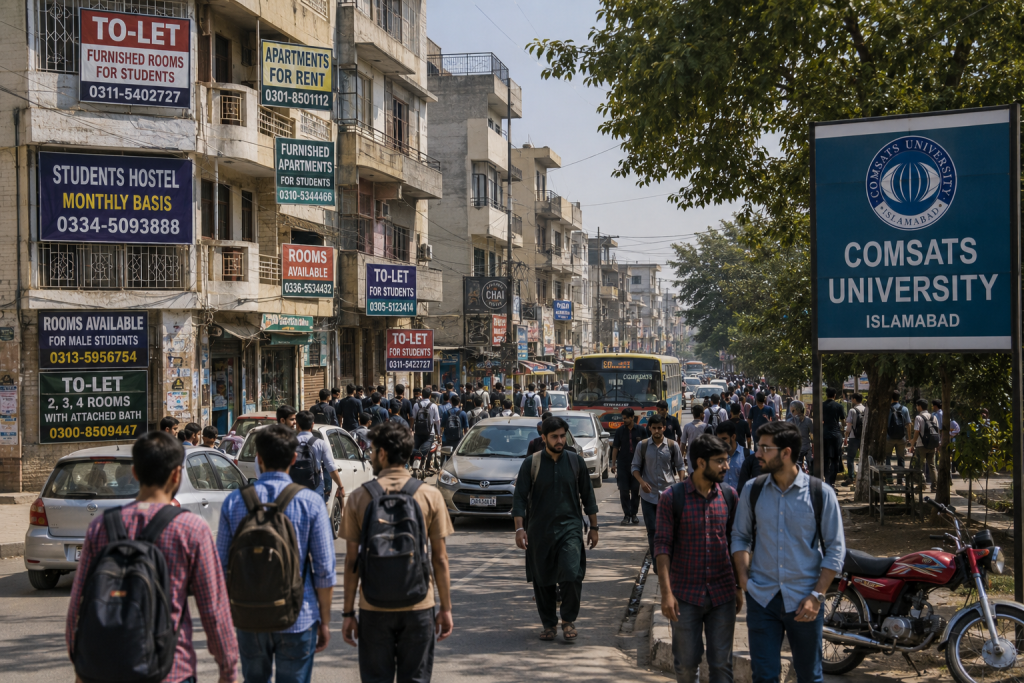
The rental situation near Pakistani universities is not what it was five years ago. Several forces are reshaping it right now, and most students don’t find out until they’re already committed to a bad deal.
Rising enrollment pressure. Enrollment data from the Higher Education Commission indicates a sustained upward trend in university intake across Pakistan over the past several years. More students competing for the same limited housing stock near campuses pushes prices up every single admissions cycle. Landlords near FAST, NUST, and UCP know exactly when enrollment season starts — and they price accordingly.
Informal market dominance. Unlike commercial real estate, student rentals in Pakistan operate almost entirely through word of mouth and broker networks. There’s no centralized listing database. There’s no standard lease format. A lot of students don’t realize this until they’ve already wasted two weeks searching on Zameen.com and OLX for units that are either already rented, misrepresented, or priced for families — not students.
Landlord-tenant power imbalance. The Punjab Rent Restriction Ordinance does provide tenants with legal protections against arbitrary eviction and rent increases — but most student renters have never heard of it, let alone used it. Landlords in high-demand campus areas count on that knowledge gap.
Know Your Budget Range Before You Search a Single Listing
Setting a budget sounds obvious. Most people skip it completely and search blind.
The reality of affordable homes for rent near universities in Pakistan looks different city to city. In Lahore, a shared room in a hostel-style setup near Gulberg or Canal Road can run PKR 8,000–12,000 per month. A small self-contained unit in Johar Town — walking distance to UCP or close to PU via transport — typically starts around PKR 18,000 and goes to PKR 28,000 for anything decent.
Faisalabad is notably more budget-friendly. Areas near NTU or UAF have single-room setups available in the PKR 7,000–14,000 range more consistently than Lahore. I’ve personally noticed that the pricing gap between Lahore and Faisalabad for similar room types is often PKR 4,000–8,000 per month — which adds up to a significant annual saving for a student on a tight allowance.
In Karachi, the geography makes it harder. Areas near NED or Karachi University in Gulshan-e-Iqbal or University Road can range from PKR 12,000 for a basic room-share to PKR 35,000+ for a self-contained flat. Rawalpindi near NUST or COMSATS, tends to sit in the middle range — PKR 12,000–22,000 for decent shared arrangements near the campus belt.
The numbers vary. But the direction is consistent: always calculate your total monthly cost including utilities, transport, and internet — not just the quoted rent.
Understand the Three Types of Near-Campus Housing
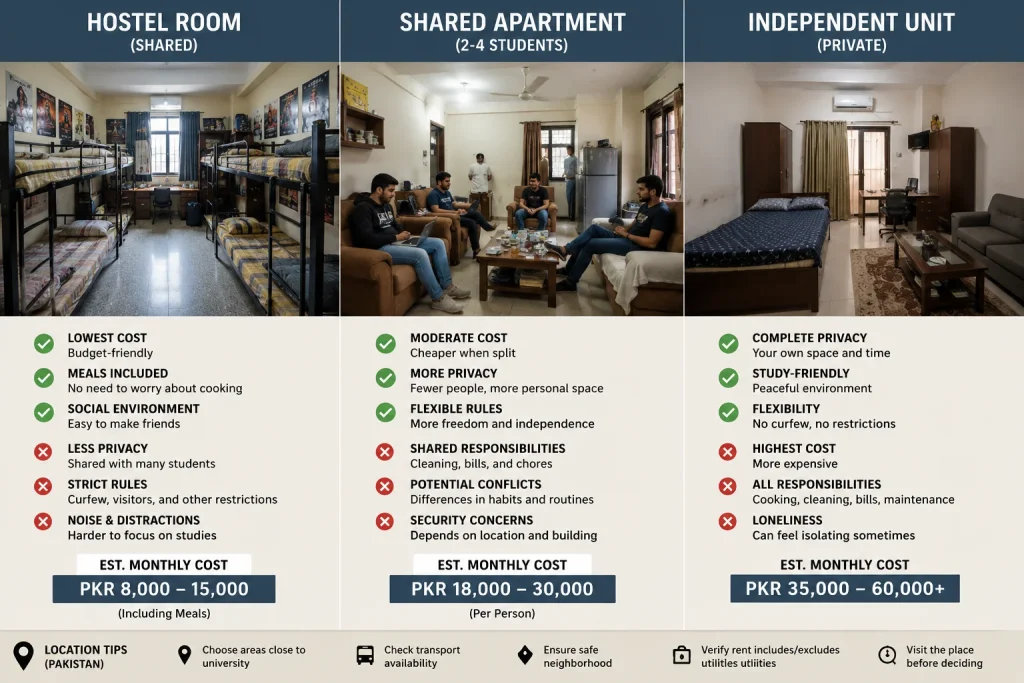
Not every housing option near a university is the same type of arrangement. Treating them as interchangeable is where a lot of students get confused.
On-campus or affiliated hostels are typically the most affordable option when available — often PKR 5,000–9,000 per month including meals in government universities. The catch: availability is limited, priority often goes to out-of-city students first, and conditions vary wildly from one institution to the next. Apply early, directly through the university’s student affairs office.
Private hostel-style buildings have expanded significantly in cities like Lahore, Karachi, and Islamabad. These are purpose-built or converted buildings renting individual rooms or shared doubles. Prices typically run PKR 10,000–18,000/month. Some include basic meals, some don’t. The quality control is inconsistent — I’ve seen genuinely well-run setups near LUMS in DHA and genuinely terrible ones in the same price bracket.
Independent flats or portions are what most students eventually land on after their first year. This is where the real value is — a group of 3–4 students splitting a small 2-bedroom flat in a residential colony adjacent to campus. Near Punjab University, that means areas like Faisal Town or Garden Town. Near FAST Lahore, that’s the bands of colonies off Main Boulevard or Canal Bank Road. Per-person cost drops significantly, and you get proper living space.
Where Exactly to Search (And Where Not To Waste Time)
Knowing what type of housing you want is step one. Knowing where to actually find it is where most guides stop being useful.
Start with university notice boards — physical ones. This sounds outdated. It isn’t. The most current, legitimate listings near any Pakistani campus are still posted on physical department notice boards, student union offices, and cafeteria bulletin boards. Landlords in adjacent colonies specifically target these boards because they know students look there first.
WhatsApp groups are your second-best tool. Every university department has unofficial student WhatsApp groups. Every batch has a housing channel or knows someone who does. Ask in these groups within the first 48 hours of your search. You’ll get word-of-mouth leads that never appear on any property website.
OLX and Zameen.com have a role — but a limited one. These platforms are useful for getting a price baseline in a given area. They’re not reliable for finding actual student-appropriate rentals, because most listings there target families or young professionals, not shared student setups. Honestly, this surprises a lot of people who rely on them entirely.
Avoid broker-first searching. Brokers near universities in Lahore, Islamabad, and Karachi typically charge one month’s rent as commission. For a PKR 15,000 unit, that’s PKR 15,000 upfront — on top of advance rent and deposit. If you find the same unit directly from the landlord through a notice board lead, you save all of that. Use brokers only if you’ve exhausted direct leads.
The Lease Agreement: What Pakistani Students Almost Always Skip
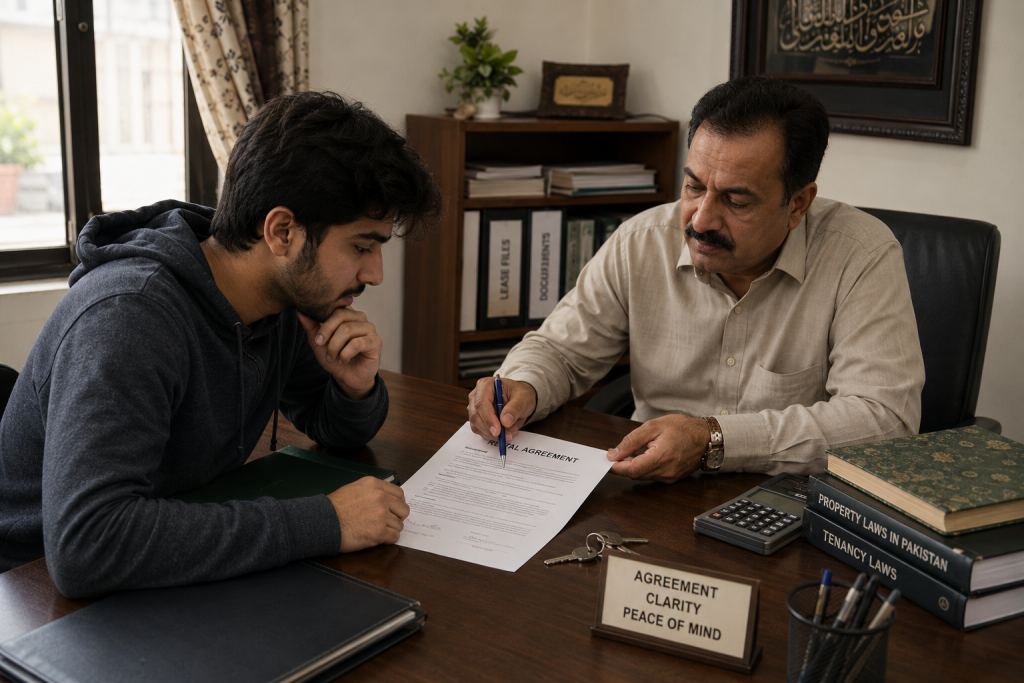
Signing a lease in Pakistan for student housing feels like a formality. It isn’t — and skipping it properly is the single most common mistake renters make.
A verbal agreement is almost impossible to enforce. Even a simple written agreement — the unit address, monthly rent, advance amount, notice period, and both signatures — creates a paper trail that protects you under the Punjab Rent Restriction Ordinance or its equivalents in Sindh and KPK. Landlords sometimes resist written agreements because it limits their ability to arbitrarily raise rent mid-year. That resistance itself tells you something worth knowing before you sign.
During my own research across Lahore and Faisalabad, the pattern that came up most consistently was students paying a full two- to three-month advance on the assumption it would be refunded at departure — and then discovering the landlord was keeping it against fabricated deductions. A written agreement specifying the advance amount and conditions for refund eliminates most of that risk. Not every landlord will cooperate — but a fair one will.
Important: Get a rent receipt for every payment you make. A simple paper receipt with the landlord’s name, amount, date, and signature is your only proof of payment history if a dispute arises.
The advance amount varies. Near university areas in Lahore, one to two months advance is standard. Some landlords in Karachi ask for three months. Anything beyond three months without a formal written lease should raise a flag.
Red Flags That Indicate a Bad Rental Situation
Some problems with student rentals near Pakistani universities are predictable. Once you know what they look like, you stop walking into them.
The unit that’s priced 20–30% below every comparable option in the same area usually has a reason. Sometimes it’s an undisclosed structural issue — water seepage, a broken bathroom, or an illegal subdivision that leaves you without proper ventilation. Sometimes it’s a landlord who cycles through student tenants every few months, keeping advances along the way. I’ve seen this pattern repeatedly near COMSATS Lahore and near Mehran UET in Jamshoro.
Watch for these specific signals:
- Landlord is reluctant to show the unit during daylight hours
- Existing tenants seem uncomfortable or avoid eye contact when you visit
- The electricity meter is shared between multiple units without clear sub-metering
- No clear answer given on who handles repairs or maintenance
- Pressure to sign or pay same-day without time to think
Your experience may differ depending on the specific street you search. But these patterns cross city lines in Pakistan — they’re not Lahore-specific or Karachi-specific.
Utilities, Internet, and Hidden Costs That Blow Student Budgets
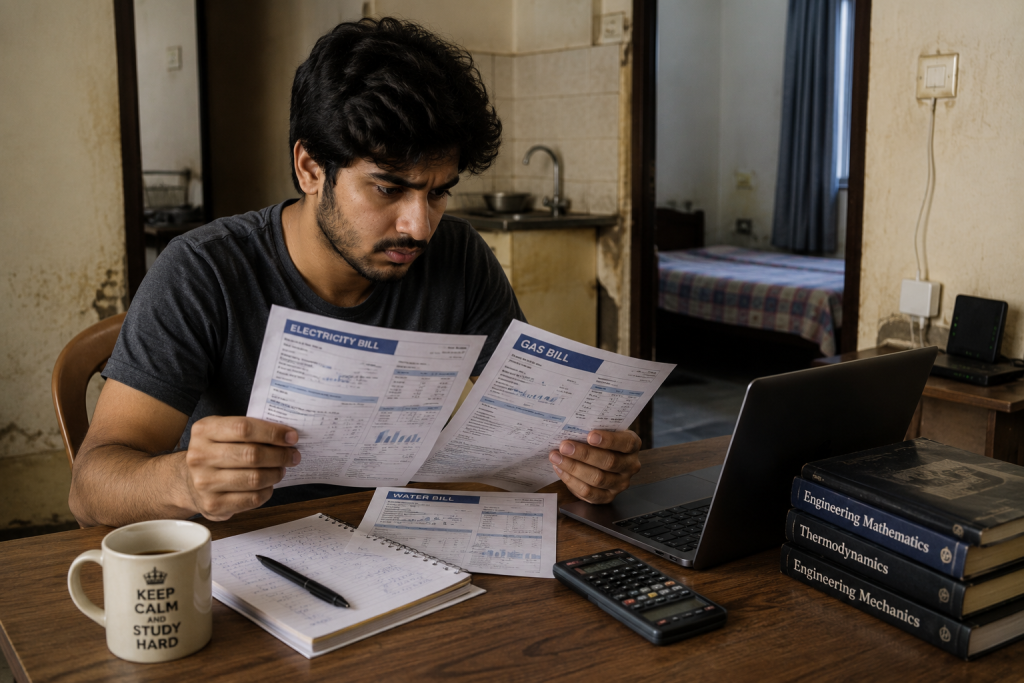
The rent quoted is never the full cost. This is especially true for affordable homes for rent near universities in the PKR 10,000–20,000 bracket.
Electricity in Pakistan has become a significant variable. A small room or studio unit running one AC during Lahore or Multan summers can add PKR 4,000–8,000 per month to your cost in peak months. Units described as “fully furnished” often include only a fan and maybe a geyser. Ask specifically what appliances are included, whether the electricity connection is separate, and what the last three months’ bills looked like.
Water charges are often bundled into rent in older residential colonies near universities — but not always. In newer developments or subdivided portions, water can be an additional PKR 500–1,500 per month. Gas connections vary by city; in Islamabad and parts of Rawalpindi, cylinder dependency adds unpredictable monthly cost.
Internet is the one most students forget to factor in. A decent broadband connection — around 10–20 Mbps, sufficient for coursework — runs approximately PKR 1,500–2,500/month in most university cities. Some private hostels include it in the package. Most independent rentals don’t.
The honest number for a student living in a shared apartment near a major Pakistani university, accounting for all of this, is typically PKR 12,000–20,000 per person per month in Lahore and Islamabad, PKR 9,000–15,000 in Faisalabad and Hyderabad. Factor that in before you commit to a rent that seems too comfortable on paper.
Negotiating Rent in Pakistan’s University Areas (Yes, You Can)
Most students assume the quoted price is fixed. It isn’t — especially outside enrollment season.
The leverage a student renter has is timing and commitment. If you’re searching in January, March, or early summer — before the main enrollment wave — landlords in campus-adjacent areas have more empty units than usual. That’s when a respectful counter-offer lands better. A PKR 18,000 asking price has room to move to PKR 15,000–16,000 if you can commit to a six-month or twelve-month agreement upfront and pay promptly.
When I was tracking rental patterns in Johar Town last year, landlords who had faced two or three months of vacancy were consistently more flexible on price than those with fresh units. The key is to not negotiate from desperation — visit two or three options before making an offer on any of them.
Longer commitment is your main bargaining chip. A student willing to commit to 12 months and pay two months in advance upfront is more attractive to a landlord than someone asking for a month-to-month arrangement at PKR 2,000 less. Offer the commitment explicitly as part of your negotiation. It works more often than most people expect.
Cities With the Best Affordable Near-University Rental Markets Right Now
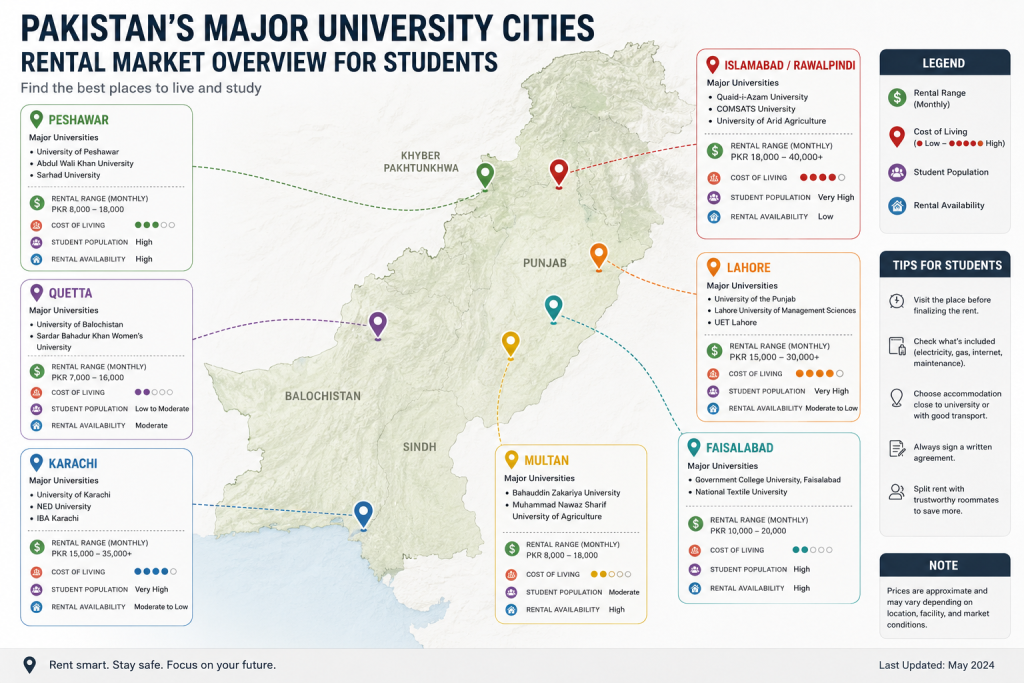
Some cities genuinely offer better value for student renters than others right now — and the difference is significant enough to factor into enrollment decisions.
Faisalabad consistently offers the most affordable near-campus rental options among Pakistan’s major university cities. Areas around NTU Faisalabad and UAF have well-established student housing colonies with supply that broadly matches demand. A decent shared arrangement here runs PKR 7,000–12,000 per person.
Hyderabad and Jamshoro benefit from lower baseline property values. Student housing near Mehran UET and the University of Sindh campus can be found in the PKR 6,000–11,000 range. The tradeoff is infrastructure — load-shedding, water supply inconsistency, and transport options are factors Lahore students take for granted.
Rawalpindi/Islamabad is the most expensive corridor for affordable homes for rent near universities. The NUST H-12 campus area, COMSATS Islamabad, and AIOU all sit in a zone where student housing has been pushed up by general real estate inflation in the twin cities. Realistic per-person costs in shared arrangements start at PKR 14,000–16,000 and move up from there.
Lahore sits in the middle. It has the widest range — from PKR 8,000 per person in genuinely basic setups in older colonies to PKR 30,000+ in more modern units near upscale campuses. The breadth of options is an advantage, but it requires more search time to find the genuine value units.
Frequently Asked Questions
What is the average rent for a student room near a university in Lahore?
A single room in a shared arrangement near major Lahore universities typically runs between PKR 10,000 and PKR 18,000 per month, depending on area and included utilities. Units near PU in Allama Iqbal Town or Faisal Town tend to be at the lower end. Areas nearer to LUMS or FAST in DHA or Johar Town skew significantly higher — PKR 20,000 to PKR 30,000 for a self-contained studio. Honestly, this varies more than most guides admit, and a unit that looks cheap on paper often hides high utility costs not included in the headline rent. Always ask to see the last three months of utility bills before committing.
Can students negotiate rent with landlords near Pakistani universities?
Yes — and more successfully than most people try. Landlords near university areas have vacancy anxiety between enrollment cycles, and a student who can commit to 12 months and pay two months advance upfront is a valuable tenant. Approach negotiation as a conversation about commitment, not just price. A lot of students don’t realize this is an option until they’ve already paid full price for a full semester. The Punjab Rent Restriction Ordinance also sets some framework around rent increases, which is useful context when negotiating renewal terms.
Is it safe to rent without a written agreement in Pakistan?
No — and I’ve seen this go badly more times than I’d like. A verbal agreement has essentially no enforceability if a landlord decides to increase rent mid-year, withhold your advance, or claim damages. Even a basic written document specifying rent amount, advance, unit address, and notice period gives you standing in any dispute. Rental disputes in Pakistan can be taken to a Rent Controller or civil court. Housing cost patterns tracked by the State Bank of Pakistan reflect ongoing pressure on renter affordability — which makes formal documentation even more important as rents rise.
What areas near universities in Karachi are affordable for students?
Areas like Gulshan-e-Iqbal, Federal B Area, and North Nazimabad are traditionally the most accessible for students near Karachi University and NED. Student housing near Gulshan tends to run PKR 12,000–20,000 for a room in a shared flat. The short answer is yes — affordable options exist — but the full answer is more complicated because Karachi’s transport situation means proximity to campus matters more than in smaller cities. A unit that saves you PKR 3,000/month on rent but adds an hour of commute each way isn’t actually saving you money.
When is the best time to find near-campus rental housing in Pakistan?
March through May is consistently the best window for finding affordable homes for rent near universities before the peak enrollment rush. Landlords are still competing for tenants before July/August applications finalize, and you have real negotiating room. December through January is a secondary opportunity — mid-year vacancies after first-semester students leave create temporary availability, sometimes at reduced rates. Avoid searching in July and August if you can help it; that’s when demand peaks and landlords hold firm on price. Enrollment data from the Higher Education Commission suggests intake concentrates in the July–September window — so searching even a few weeks before that curve starts gives you meaningful advantage.
What You’re Really Getting Into — And How to Come Out Ahead
Finding near-campus student housing in Pakistan has never been a simple, transparent process. The market is informal, the pricing is inconsistent, and the protections most renters don’t know about exist on paper but rarely get used. None of that is unsolvable — it just requires going in with better information than most people have.
The students and families I’ve spoken with who found genuinely good, affordable arrangements near Pakistani universities almost always had two things in common: they started searching earlier than their peers, and they used social networks — university groups, senior students, department boards — rather than property platforms. That pattern holds whether you’re in Lahore, Karachi, Faisalabad, or Hyderabad.
The legal framework is on your side more than you might think. The Punjab Rent Restriction Ordinance covers tenants in Punjab, and similar ordinances exist in other provinces. Housing data from the State Bank of Pakistan and enrollment trends from the Higher Education Commission both confirm that the student housing market in Pakistan is under real and growing pressure — which means acting fast, documenting everything, and negotiating from a position of knowledge isn’t just good advice. It’s necessary.
For more reading, explore: – How to Evaluate a Rental Agreement in Pakistan Before You Sign – Best Residential Colonies Near Major Universities in Lahore – Student Budget Planning Guide for Pakistani University Cities
[META DESCRIPTION]: Find affordable homes for rent near universities in Pakistan — real price ranges, city comparisons, negotiation tips, and legal rights explained for 2026. (158 characters)
⚠️ Disclaimer: This article is for general informational purposes only and does not constitute legal, financial, medical, or investment advice. Laws, rates, and market conditions in Pakistan change regularly. Always consult a qualified professional and verify with relevant government authorities before making any major decision.
About the Author
Farhan Khan is a WordPress developer and content strategist based in Pakistan. He writes practical, research-based guides on real estate, freelancing, technology, and online income — drawing on direct market observation and publicly available data to help Pakistani readers make smarter financial decisions.