

Family Rent House in Pakistan – Avoid Costly Mistakes (2026)
Introduction
Finding a family rent house in Pakistan has become one of the most stressful financial decisions a household can make in 2026. Whether you are searching in Lahore, Karachi, Islamabad, or Faisalabad — every family is trying to balance budget, safety, school distance, and livability all at once. And that balance has become significantly harder to strike.
Three years ago, a decent 3-marla house in a mid-tier Lahore neighbourhood rented for Rs. 28,000–32,000. Today that same house starts at Rs. 50,000 — and that is after negotiation. Rents have climbed, landlords have become more selective, and the documentation process has grown more formal. Families that walk into this market unprepared consistently end up either overpaying or settling for less than they need.
The good news is that with the right preparation, a suitable family rent house in Pakistan is absolutely findable — at a fair price, with a proper agreement, in an area that genuinely works for your household. It just requires knowing what to look for, what to ask, and what to refuse. If you are renting for the first time, our breakdown of what first-time renters in Pakistan must know before signing anything is worth reading alongside this guide.
This guide covers everything: budget planning, city-wise area breakdowns, property inspection checklists, agreement must-haves, landlord red flags, and move-in protection steps. Everything a Pakistani family needs — in one place.
What Pakistani Families Are Actually Facing in the Rental Market Right Now
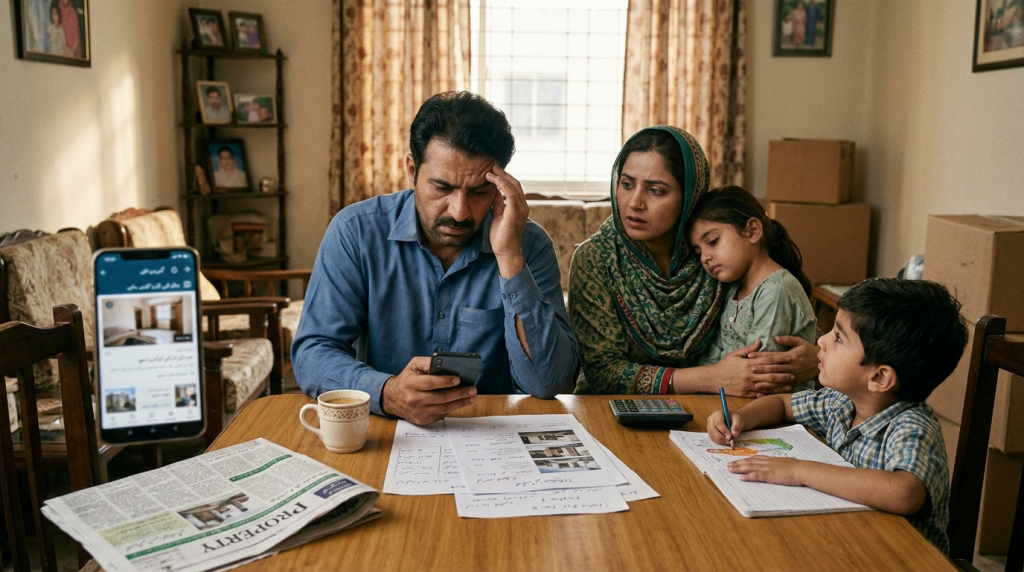
If you are budgeting based on what rents looked like two or three years ago, that number needs a serious revision.
Rents have risen sharply across major cities. Recent cost trends tracked by the State Bank of Pakistan suggest that residential rents in Pakistan’s urban centres have seen notable upward movement over the past two to three years. In Lahore’s DHA and Bahria Town, monthly rents for family-sized units now commonly range from Rs. 60,000 to Rs. 1,50,000 depending on size and amenities. Karachi’s PECHS, Gulshan-e-Iqbal, and North Nazimabad show a similar pattern. Even mid-tier areas that were once affordable have moved up considerably.
The demand-supply gap keeps widening. Pakistan’s urban population continues to grow rapidly. In Lahore, Karachi, Islamabad, and Faisalabad, a large proportion of families rent long-term because purchasing property remains out of reach for most income brackets. This sustained demand keeps the rental market firmly in favour of landlords — which makes preparation and negotiation skills more valuable than ever for tenants.
Landlords are becoming more formal. Housing data patterns from LDA (Lahore Development Authority) observers and real estate professionals indicate that landlords increasingly prefer stamped agreements, documented advance amounts, and CNIC verification — especially for family tenants. In several Lahore and Karachi neighbourhoods, two months’ advance has become the standard where one month previously sufficed.
These three forces together create a rental environment where an unprepared family does not just face inconvenience — they face real financial loss. Preparation is what separates a good rental outcome from a frustrating one.
Step 1: Family Rent House in Pakistan – How to Plan Your Budget Realistically
Looking only at the monthly rent is the single most common — and most expensive — mistake families make when searching for a family rent house in Pakistan.
A realistic rental budget includes all of the following:
- Monthly rent: Should not exceed 30–35% of total household income
- Security deposit / advance: Typically two to three months’ rent — paid upfront in full on signing day
- Dealer or agency fee: Usually one month’s rent if you find the property through a broker
- Utility connection costs: WAPDA, gas, internet — some properties have these set up, others require fresh connections
- Minor repairs or repainting: Some landlords hand over freshly painted units; others do not. If not, that cost falls on you
- Shifting expenses: Truck, labour, and packing for a medium-sized family in Lahore or Karachi typically costs Rs. 15,000–35,000
Important: Do not mentally treat the deposit as money you will definitely get back. Technically it is returnable — but deposit disputes are common in Pakistan, and resolution is not always quick or clean. Budget as though that amount is locked for the duration of the tenancy.
Here is a real example to make this concrete. A 3-marla house in Johar Town, Lahore currently rents for approximately Rs. 45,000–55,000 per month. Add two months’ advance (Rs. 90,000–1,10,000) and one month’s dealer fee. On the day you sign, you are walking in with Rs. 1,80,000–2,20,000 in hand — not just one month’s rent. Families who know this go prepared. Families who don’t are blindsided at the worst possible moment.
Honestly, sorting out your full budget before you start viewing properties saves more time and stress than anything else in this process.
Step 2: Best Areas for a Family Rent House in Pakistan
Area selection should begin with your family’s specific priorities — not with whatever properties happen to appear in your search results. Every family’s checklist is different, and the right neighbourhood for one household may be completely wrong for another.
School proximity. If your children are school-going age, a school within 2–3 kilometres is a practical necessity — particularly given traffic conditions in Lahore, Karachi, and Islamabad. Bahria Town Lahore has excellent schools, but if your house is in Phase 8 and the school is in Phase 1, the daily commute becomes a daily burden.
Market and hospital access. For a family unit, this is not a luxury — it is a requirement. In an emergency, a hospital should be reachable within 10–15 minutes. Karachi’s Gulshan-e-Iqbal Blocks 2–13 have this advantage — Agha Khan Hospital and Liaquat National are both reasonably accessible from that belt.
Street security and neighbourhood environment. No property listing will tell you this accurately. Visit the area at different times — once on a weekday morning and once on a weekend evening. Observe street lighting, how neighbours interact, whether there is any suspicious activity. This is something experienced renters know and rarely skip.
Load shedding schedule. This is the detail that catches families off guard more than almost anything else. Ask residents in that specific area which feeder their street falls under and how many hours of load shedding they experience daily. LESCO, KESC, and other distribution companies publish area-wise schedules — check them before committing.
I have seen many families in Lahore and Karachi skip the neighbourhood visit and rely only on photos and listings — and then spend months dealing with problems that a single visit would have revealed.
City-by-City Area Overview
Lahore: DHA and Bahria Town are the premium tier — family rent house in Pakistan’s most sought-after Lahore addresses run Rs. 55,000–1,50,000+. Johar Town, Gulberg, and Faisal Town are solid mid-range options. Iqbal Town, Gulshan Ravi, and Samanabad offer more affordable rents. LDA City is still developing — check connectivity before committing.
Karachi: PECHS, Gulshan-e-Iqbal, and DHA are established family areas with good infrastructure. North Nazimabad, Buffer Zone, and Nazimabad are mid-tier with reasonable facilities. Federal B Area and Gulberg Town are more affordable. For Karachi specifically, always speak with local residents directly — KDA (Karachi Development Authority) data is too general to rely on alone.
Islamabad / Rawalpindi: I-8, I-10, G-9, and G-10 are CDA-approved family-friendly sectors with solid infrastructure. Bahria Town Rawalpindi has a wide variety of options — verify inner development and utilities before signing. CDA (Capital Development Authority) maintains an approved sectors list that is worth cross-checking.
Faisalabad: Susan Road, Millat Road, and Peoples Colony are popular family rental areas. Rents are comparatively lower — a 3-marla family unit is available in the Rs. 25,000–40,000 range.
Peshawar: Hayatabad and University Town are the go-to family areas with better infrastructure. PDA (Peshawar Development Authority) is the relevant authority here for approved housing schemes.
This varies quite a bit from area to area — in any city, a 20-minute conversation with someone who lives there tells you more than any online list.
Step 3: How to Find a Family Rent House in Pakistan – The Right Channels
Using the right search channels cuts your timeline significantly. Most families rely on just one or two sources and miss better options hiding elsewhere.
Online portals. Zameen.com and Lamudi.pk are both reasonably active in 2026. One important thing to understand: the listed price and the actual negotiated price are typically 10–20% apart. What you see online is always a starting point, never a final number.
Local property dealers. Every neighbourhood has one or two dealers who work that specific area and know about properties that never get listed online. Their commission is standard — usually one month’s rent — but a good dealer saves you significant time and shows you options you would never find yourself.
Word of mouth. This is an underrated channel in Pakistan. Tell your office colleagues, relatives, and acquaintances that you are looking. Some of the best family rental properties in Pakistan move purely through referrals — no listing, no board outside the door, no dealer involved.
Direct landlord contact. In some areas, a board saying “Makan Kiraye par dena hai” is posted outside the property. Walking the area yourself can surface these directly — no dealer fee, direct negotiation from the start.
Most dealers will not volunteer this unless you ask directly — specifically ask whether any properties are coming available soon that are not yet listed. In some cases you get advance notice that makes a real difference.
Step 4: Property Inspection – What to Actually Check During a Visit
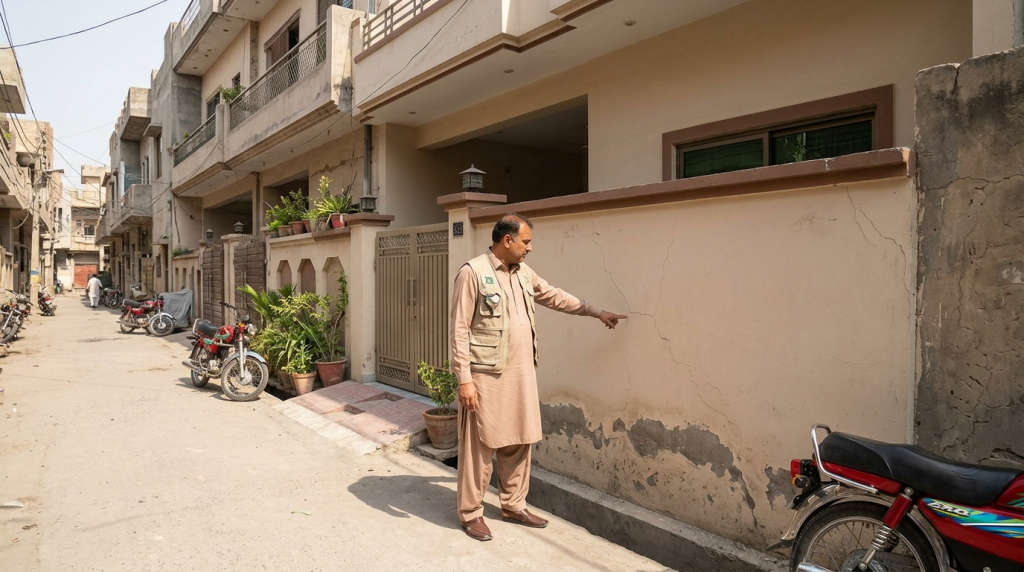
Visiting a property and genuinely inspecting it are two different things. Most families spend 15 minutes looking at rooms and leave. That is not enough.
When visiting a potential family rent house in Pakistan, check these specifically:
- Water pressure and supply timing: Test during morning peak hours — 7:00–9:00 AM if possible. Many buildings have acceptable pressure at off-peak hours but fail at the exact time your family needs it most
- Roof and wall condition: Look for seepage marks, paint discolouration, and moisture in corners. A summer visit can hide monsoon damage — visualise what those walls look like after three days of heavy rain
- Electrical points and capacity: Count AC points per room. Check whether a geyser connection exists. Bad or insufficient wiring is a headache that typically shows up three to six months after move-in
- Kitchen and bathroom drainage: Run the taps, flush the toilets. Drainage issues are among the most common — and most annoying — problems in rental properties
- Natural ventilation: Without cross-ventilation in a Pakistani summer, air conditioning runs constantly. Your electricity bill reflects that immediately
A practical tip that experienced renters use: during the visit, switch on all lights, turn on fans, and open a tap — all at the same time. If there is a wiring issue or pressure problem, it becomes visible right then. Some landlords deliberately leave everything switched off during showings for exactly this reason.
If a landlord is rushing you through the visit or saying “you can check later” — that itself is a red flag worth noting.
Step 5: Rent Negotiation – Negotiate From Data, Not From Desperation
Negotiation in Pakistan works best when you come in with market data, not just a desire for a lower number.
Before approaching any landlord, check three to five comparable properties in the same area — either online or through dealers. Build a fair price range in your mind. When the landlord states their asking price, your reference point is the market, not your personal budget pressure.
What is actually negotiable beyond monthly rent:
- The advance amount — moving from two months to one and a half or one is difficult but not impossible in every case
- Minor repairs and fresh painting before move-in — many landlords will agree if asked directly before signing
- Annual rent increase cap — this must be written into the agreement explicitly. Do not leave it verbal
- Parking, roof access, or storage room inclusion — sometimes free, sometimes charged separately. Always ask
The single most effective negotiation tool for families is positioning. Landlords generally prefer family tenants — stable, long-term, less transient than young professionals or students. Use that reality to your advantage. Make it clear you are looking for a long-term arrangement, that you will maintain the property properly, and that you will pay on time. That positioning shifts the conversation in your favour more than any price argument.
A lot of first-time renters skip negotiation entirely — they assume the price is fixed or feel uncomfortable pushing back. In every major Pakistani city I have researched, I have not found a single family rent house listing where some form of negotiation was not possible.
Step 6: The Rent Agreement – Read It, Understand It, Then Sign
The rent agreement is where most Pakistani family rental problems begin — not because agreements are signed, but because they are signed without being read properly.
A proper rent agreement for a family rent house in Pakistan must include:
- Full property description: Exact address, floor, marla size, and included features
- Monthly rent amount: In both words and figures
- Advance/deposit amount: Exact figure, clearly stated
- Tenancy start date and duration: Typically 11 months or one year
- Notice period: How many days either party must give before terminating (30–60 days is standard)
- Annual rent increase clause: The percentage must be written explicitly. If it is missing, the landlord can raise rent by any amount at renewal
- Maintenance responsibility: Who fixes what — broken fixtures, plumbing, electrical issues
- Sub-letting restriction: Clearly stated
- Utility bill responsibility: Who pays — landlord or tenant
- Number of permitted occupants: Some landlords restrict this
Important: The agreement must be on stamp paper — Rs. 500–1,000 — and should be notarized. A plain paper agreement holds significantly less legal weight. This is the cheapest protection you can buy for a tenancy worth hundreds of thousands of rupees.
According to FBR (Federal Board of Revenue) guidelines, rental income is a taxable component of a landlord’s declared income. CNIC verification is increasingly mandatory in urban areas. The rental market is becoming more formal — tenants who come prepared with documentation make the process smoother and signal credibility to landlords.
In most cases, landlords agree to certain conditions verbally at the time of deal-making. Get every single one of those commitments in writing. What is not written does not exist — that is the practical legal reality of rental disputes in Pakistan.
Step 7: Landlord Red Flags – Recognise Them Before You Sign
Most families I have spoken to who ended up in difficult rental situations say the warning signs were there from the first meeting. Knowing what to look for is half the protection.
Red Flag 1 — Reluctance to show original ownership documents. If a landlord will not show the property’s title deed, registry, or ownership proof — regardless of the excuse — that is a serious problem. Some properties are rented out by people who do not legally own them, or that are already mortgaged. LDA in Lahore and CDA in Islamabad both provide avenues to verify property ownership in approved schemes — use them.
Red Flag 2 — Full advance required before the agreement is drafted. If someone is pushing for the complete advance payment while saying the agreement will be handled “tomorrow” or “later” — stop. Agreement first, payment after. No exceptions.
Red Flag 3 — Announced habit of frequent unannounced visits. Family privacy is not negotiable. If a landlord mentions during the initial meeting that they regularly drop by unannounced or want to “check on things” frequently — that pattern will not improve once you are a tenant. Get the visit protocol written into the agreement.
Red Flag 4 — Pre-printed agreement with no flexibility. If a landlord presents a ready-made agreement and resists any modification — that document was written entirely in the landlord’s favour. Request a few changes. How the landlord responds tells you everything about how disputes will be handled later.
If a landlord refuses to show original ownership documents — walk away. The time lost finding another property is significantly less costly than the problems that follow from ignoring this step.
Step 8: Move-In Day – The Final Protection Step Most Families Skip
Agreement signed, advance paid, keys in hand — there is one more step that is consistently skipped and consistently regretted.
On move-in day, conduct a property condition walkthrough with the landlord present. Every existing defect — seepage stains, cracked tiles, a faulty geyser, a dented door frame, broken cabinet hinges — photograph it. Send those photos to the landlord via WhatsApp with a written message stating: “These conditions were pre-existing at the time of move-in.”
Why does this matter? Because when you eventually vacate the property, landlords frequently attempt to deduct repair costs from the deposit for damage that existed before you arrived. Documented photographic evidence with a timestamp eliminates that dispute before it starts.
Record the electricity and gas meter readings on move-in day as well — dated and saved. This small step prevents billing arguments that arise more often than most tenants expect.
Frequently Asked Questions About Family Rent House in Pakistan
What is the average monthly rent for a family house in Pakistan in 2026?
It depends heavily on the city and area. Broadly speaking, a decent family unit of 3–4 marla in Lahore rents for Rs. 35,000–80,000 per month. Karachi shows a similar range, with premium areas reaching Rs. 80,000–1,50,000 or more. In Islamabad’s CDA sectors, Rs. 50,000–1,00,000 is a common range for family-sized properties. Recent cost patterns tracked by the State Bank of Pakistan suggest rents have been on a consistent upward trajectory for the past two years — expecting 2022 prices in 2026 will lead to a budget shortfall. Always add a 10–15% buffer to your estimate.
How long should a rent agreement be for a family rent house in Pakistan?
The standard is 11 months or one year. Eleven months is popular because it does not legally require registration — but that does not mean the agreement should be weak. A properly drafted agreement on stamp paper, notarized, is enforceable at 11 months. Landlords who insist on very short agreements often do so because they want the flexibility to raise rent aggressively at renewal. An explicit annual increase cap, written into the agreement, protects against this. Most people do not negotiate this clause — and regret it at the first renewal.
Can I verify property ownership before renting a family house in Pakistan?
Yes — and you should. LDA-approved societies in Lahore can be verified through LDA’s official website or offices. For Islamabad, CDA’s portal provides sector-wise information. Asking a landlord to show the title deed, registry, or allotment letter is entirely within your rights as a prospective tenant. In practice, this varies quite a bit depending on the area and landlord — but no matter where you are renting, this verification step should not be treated as optional. One phone call or office visit can protect you from a significant fraud.
What is the difference between advance and security deposit in Pakistani rental agreements?
These terms are often used interchangeably in Pakistan, but technically they mean different things. An advance is an amount that gets adjusted against the final months of the tenancy — essentially prepaid rent. A security deposit is held by the landlord and returned at the end of the tenancy, provided the property is in acceptable condition. The agreement must specify exactly when and how the deposit is returned. This is actually more common than landlords admit — vague agreements on this point lead to the most frequent disputes between tenants and landlords in Pakistan. Always get the return terms in writing.
Do landlords in Pakistan treat family tenants differently from single tenants?
In many cases, yes. Some landlords impose restrictions on large families, pets, or specific occupations — these must be stated in the agreement to avoid conflict later. On the positive side, family tenants carry a genuine negotiating advantage: landlords typically view families as more stable, responsible, and long-term than single occupants or young professional groups. Using that positioning during negotiation — emphasising long-term intent and property care — often achieves better terms than price-focused arguments alone. CNIC verification and sometimes a character reference are increasingly requested in urban areas as the rental market formalises.
Conclusion
The families who fare best in Pakistan’s rental market are not the ones with the largest budgets — they are the ones who came prepared. A clear budget, a well-researched area, a properly drafted agreement, and a documented move-in walkthrough are the four things that separate a smooth tenancy from a stressful one.
Authorities like LDA, CDA, and FBR exist as verification and protection tools, not just regulatory bodies. Families who know how to use them — verifying ownership, understanding agreement tax requirements, cross-checking approved schemes — consistently avoid the problems that blindside unprepared tenants. The State Bank of Pakistan’s trend data is a useful reality check when budgeting, not just a statistic for economists.
Finding a family rent house in Pakistan in 2026 takes more effort than it did three or four years ago. The market has genuinely become more demanding. But the process is learnable, the red flags are recognisable, and the right property is findable — for families who approach it with the right information in hand. You now have that information.
For more reading, explore: – First-time renter’s complete guide to renting in Pakistan – LDA approved societies in Lahore 2026 – full verification guide – What must be in every Pakistani rent agreement – clause by clause
⚠️ Disclaimer: This article is for general informational purposes only and does not constitute legal, financial, or investment advice. Laws, rates, and market conditions in Pakistan change regularly. Always consult a qualified professional and verify information with the relevant government authorities before making any major decision.
About the Author
Farhan Khan is a WordPress developer and content strategist based in Pakistan. He writes practical, research-based guides on real estate, freelancing, technology, and online income — with a focus on helping Pakistani readers make smarter financial decisions. His work draws on official sources and direct market experience.